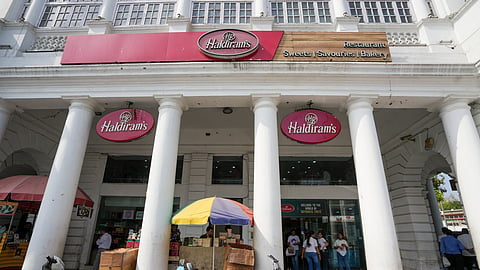

Haldiram’s, the family-led Indian snacks and sweets maker, plans to open 20 stores outside India in the next two years, primarily in the US, UK, and the Middle East. In a broader push to become an international food brand, it will make a variety of snacks for global consumers, said Rhea Agarwal, commercial director for the UK and Europe, in an interview with The Financial Standard. “My aim is to increase the consumer base abroad the way we have in India,” Agarwal said.
The firm has raised more than $1.6 bn in private equity capital from four large global investors. Singapore’s sovereign investor, Temasek Holdings, which led the funding, infused nearly $1 bn for a 10% stake. Abu Dhabi’s International Holding Company and New York-based Alpha Wave Global jointly took about 6%. L Catterton, the consumer-focused private equity firm backed by LVMH, acquired a minority stake in December 2025. Though the finer details of the transactions are private, the funding valued Haldiram’s at $10 bn.
Agarwal, who joined part-time during the pandemic and took on the commercial role in September 2024, said the group sought outside capital because its business had reached saturation. The investors, she said, had widened the channels it uses, and their expertise and capital would drive its global growth ambitions. She added that traditional family-run businesses in India are complex and need fresh perspectives from outside experts to expand beyond what they are used to doing.
The target customer in each country is a local one, not just Indians abroad, she said. The global business is at an early stage and is similar to a start-up, she added. “I get to build something of my own while carrying the legacy forward,” Agarwal said.
“Revenue and profitability are obviously important because a business needs to be commercially sustainable, but I believe strong financial performance comes from getting the fundamentals right first. Especially as we grow internationally,” the official said.
Haldiram’s opened a 3,000 sq ft restaurant at Leicester Square in London in June 2026, and its first US restaurant in Frisco, Texas, this month. The menu is also widening. “A burger patty is in development, cheese and jalapeño poppers are already in the frozen range, and chilli and lime flavours are being explored for snacks,” Agarwal said.
Frozen foods are one of three revenue streams, alongside dry snacks and sweets, she said. The food range has been relaunched for US retail, with fillings such as quinoa and sweet potato, broccoli and cheese, and chilli paneer. In the UK, the company is exploring further restaurant sites in areas such as Harrow and Southall.
Some of the prominent global markets for the brand are Canada, Europe, Australia, New Zealand, the Far East, Moscow, Japan, Sri Lanka, Nepal, and Thailand. “Haldiram’s expansion mirrors a broader trend of Indian food and beverage brands making waves globally,” said Kotak Neo in a report. Several Indian brands, including Amul, MTR Foods, and Saravana Bhavan, have a strong overseas presence, it said.
Alpha Wave Global’s experience in scaling brands worldwide will be crucial in helping Haldiram’s position itself as a global ethnic food giant, Kotak analysts said.
Haldiram’s, a household name in India’s packaged foods segment, was formed by merging the family’s packaged-food businesses in the Delhi and Nagpur branches. The company produces more than 150 food varieties, including gulab jamun, across eight facilities in India, generating annual revenue of more than ₹8,000 crore.
It is too early to give a timeline for the firm’s IPO, Agarwal said. An IPO in 2027 had been reported earlier. She also said there were no plans to use the private equity funds for acquisitions.
The family’s funding rounds followed several M&A discussions. In 2023, Tata Consumer Products reportedly negotiated for a 51% stake. In 2024, a consortium led by US private equity firm Blackstone, with Abu Dhabi Investment Authority (ADIA) and Singapore’s GIC, pursued a stake of up to 76%. Earlier approaches from PepsiCo and Kellogg’s had failed over the price.
US-based private equity firm General Atlantic invested ₹2,500 crore this year in Gujarat-based rival Balaji, which is also expanding aggressively. Globally, private equity investors are increasingly relying on secondary sales in the food sector. Around 144 private equity deals were recorded in global food and beverage consumer goods in the first quarter of 2026.
