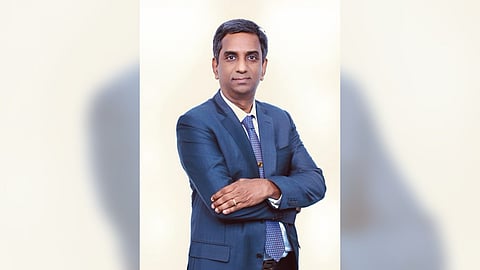


Investors are looking beyond large mutual fund houses for diversification, creating an opportunity for mid-sized asset managers to gain market share, said Anand Radhakrishnan, managing director of Sundaram Asset Management Company.
"An investor who has allocated 60%-70% of their mutual fund portfolio to a few large fund houses may consider allocating another 5% to other fund managers. That is giving us good visibility of growth," Radhakrishnan said.
In an exclusive interview with The Financial Standard, Radhakrishnan discussed fund flows, valuations and the fund house’s specialised investment fund (SIF) strategy. Excerpts from the interview.
As the industry grows, what is the opportunity for mid-sized mutual fund houses like yours to gain market share?
There is a genuine need for diversification. Some of the larger flexi-cap, mid-cap and small-cap funds have become very big. Investors are now asking which are the good mid-cap and large-and-mid-cap funds beyond large fund houses.
Investors who have allocated 60%-70% of their mutual fund portfolio to a few large fund houses may consider allocating another 5% to other fund managers. That is giving us good visibility of growth. As a mid-sized AMC, our market share is around 1.4% by assets under management (AUM), while our share of flows is around 1.2%-1.3%. We have considerable headroom to grow, and I expect the market share to become less concentrated over time as the number of AMCs has increased.
Mutual fund flows remain positive but have plateaued. What explains the slowdown?
People are investing fresh money every month, but are they investing more than they did last year? The answer is no. When investors look back and see that the money they invested has not generated returns, they become reluctant to increase their allocations. Unlike bank fixed deposits, where investors can see their money grow by 6%-8% over a year, equity investments have not delivered comparable returns. There is a bit of a look-back effect, with investors waiting for returns to improve before committing more money.
Has there been a shift in investor behaviour?
There are two kinds of investors. Those who have invested a lot in the past and are looking at their returns are slowing down. The other group comprises investors who have not invested much previously and are looking at valuations today. They see large-cap stocks as reasonably cheap and are willing to invest lump sums, particularly in areas such as banks and IT, where they may have limited exposure. Fresh allocations are coming from new investors, but not to the same extent from older investors.
What is your outlook for Indian markets amid global uncertainties?
There are two major uncertainties for India: energy prices and interest rates. The fact that crude oil prices are still above $100 a barrel is a surprise. Geopolitical developments are holding back the market’s upward movement. Investors can earn dollar returns of 7%-8% in the US, so they may not want to chase a 10% return in emerging markets where they also face currency risk. Inflation has become more persistent, and I do not think global interest rates will come down quickly. This could delay flows into emerging markets.
In India, earnings are improving while markets remain flat and valuations gradually decline. That is good. Eventually, improving earnings and lower valuations can help compensate for the impact of interest rates.
Why did Sundaram enter the SIF space with the ex-top 100 long-short SIF rather than start with popular categories like equity long-short and hybrid long-short?
At one end are products closer to liquid-plus or arbitrage strategies, while at the other are products resembling PMS and alternative investment fund (AIF) strategies, with tax benefits and a long-short component. Some fund houses have started at the lower-risk end. We have chosen to start at the other end because there is already significant money in equity-focused PMS and AIF strategies. We believe some of that money can move into SIFs, given the potential tax advantages and long-short feature. We plan to look at all categories, including debt-oriented strategies in the space.
Debt mutual funds have struggled to attract investors. What needs to change for debt funds?
Debt funds are unable to offer investors much beyond what banks provide, leaving little differentiation between bank deposits and mutual funds. Investors looking for higher yields have moved into the AIF space. Risk-taking has shifted from public markets to private markets. We have swung from one end of the spectrum to the other. There is a gap between products offering returns of around 7% and those promising 17%. Investors who want to earn 8%-8.5% need more options in between. Some regulatory changes may be needed to bridge this gap.
How has the growth of digital channels changed mutual fund distribution for Sundaram?
More business is coming through online platforms and apps, and the friction involved in physical applications is reducing. We are enabling transactions through WhatsApp and other digital channels. Digital platforms are also moving away from promoting only a few top funds and beginning to curate their offerings. I expect them to become more democratic, making mutual funds more widely available. However, advice will continue to be important. I do not see digital distribution and physical advice as mutually exclusive.