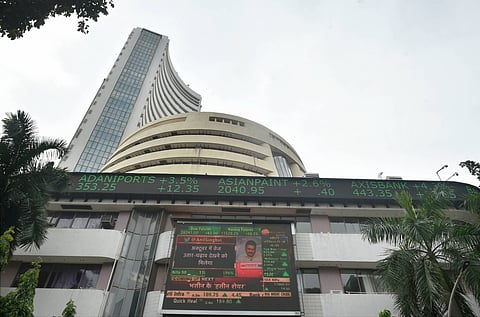


Asia's oldest stock exchange, BSE Ltd, may consider raising transaction, co-location and order-throttle charges as its derivatives business scales up, managing director and chief executive officer Sundararaman Ramamurthy said on Wednesday.
However, the timing and extent of any revision will be guided by feedback from market participants, the CEO said.
The National Stock Exchange (NSE) and BSE last revised their transaction charges on October 1, 2024, following a Securities and Exchange Board of India (Sebi) directive requiring market infrastructure institutions (MIIs) to adopt a uniform fee structure instead of the earlier volume-based slab system.
Under the revised structure, NSE charges ₹2.97 per lakh of traded value on each side in the cash market, ₹1.73 per lakh in equity futures and ₹35.03 per lakh of premium value in equity options. BSE revised the transaction fee for Sensex and Bankex options to ₹3,250 per crore of premium turnover, while charges for Sensex 50 and stock options remained at ₹500 per crore.
Changes in transaction charges would directly affect retail investors, particularly frequent cash and derivatives traders, as well as brokers and proprietary trading firms. Co-location and infrastructure charges would primarily impact high-frequency traders, algorithmic trading firms and institutional brokers.
Ramamurthy said the exchange was still in a growth phase and had room to raise charges in segments where its pricing remained below levels that the market could absorb, He was speaking during BSE’s second quarter earnings call.
The exchange reported a 45% year-on-year increase in consolidated net profit to ₹809 crore for the September quarter.
“We will do whatever the market participants find suitable,” Ramamurthy said, adding that BSE would use feedback from customers to determine any revision.
At the appropriate time and to the appropriate level, we will increase the charges, including transaction charges and the co-location charges, throttle charges, etc. All revisions will be subject to the market’s feedback.
Sundararaman Ramamurthy, CEO, BSE
BSE’s consolidated revenue from operations rose 34% to ₹1,433 crore in the quarter, compared with ₹1,069 crore a year earlier. Total income increased 36% to ₹1,551 crore. Transaction charges, the exchange’s largest revenue stream, grew 42% to ₹1,128 crore.
Operating earnings before interest, taxes, depreciation, and amortisation (Ebitda), including contribution to the core settlement guarantee fund, rose 43% to ₹973 crore. The operating Ebitda margin widened to 68% from 64% in the year-ago quarter.
Ramamurthy said the exchange’s margins were sustainable, citing cost discipline and the nature of its expenses. “I’m not able to see any reason why we will not sustain this margin because, if you look at it, our cost controls and our disciplines have been extremely high,” he said.
He added that an Ebitda margin of 65-70% appeared sustainable, unless risks that could affect the business materialised.
BSE’s cash equity business recorded its highest-ever quarterly average daily turnover of ₹10,494 crore in the September quarter. However, the exchange is yet to achieve a double-digit share of the cash equity market, Ramamurthy said.
“We are yet to reach the double-digit market share,” he said. Some clients of brokers who have completed their KYC and are eligible to trade on both BSE and the NSE have not yet been enabled to trade on BSE, he said. Ramamurthy said BSE was engaging with brokers to ensure that clients eligible to trade on both exchanges were given the option to trade on BSE as well.
In index options, BSE’s average daily premium turnover stood at ₹22,531 crore in the September quarter, down from ₹29,615 crore in the June quarter. This was the first sequential contraction, which the company attributed to compressed volatility and temporary structural shifts in participation.
The exchange, however, saw a recovery in September and a record performance in October, when the average daily premium turnover in index options reached ₹35,481 crore. It also recorded its highest single-day expiry premium turnover of ₹85,356 crore on October 22.
BSE’s mutual fund platform, StAR MF, processed 24.5 crore transactions in the September quarter, up 22% year on year. Revenue from the business rose 11% to ₹146 crore in the first half of FY27.
The exchange had around 500 co-location racks at its data centre, all of which had been allocated. It is building another 170-190 racks to provide additional capacity and a buffer for future demand, the CEO said. Revenue from co-location and other connectivity charges, including throttle charges, stood at ₹103 crore in the first half.
For the six months ended September, BSE’s consolidated revenue from operations rose 48% to ₹2,999 crore, while total income increased 49% to ₹3,257 crore. Net profit attributable to shareholders grew 53% to ₹1,683 crore. Operating Ebitda, including contribution to the core settlement guarantee fund, rose 55% to ₹2,019 crore, with the margin expanding to 67% from 64% a year earlier.