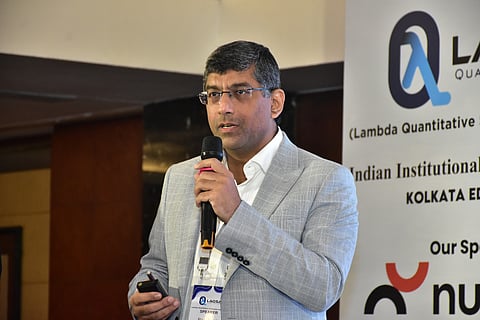


Indian equities are entering a more discerning phase, with earnings visibility, valuations, and disciplined stock selection likely to determine returns over the next 12-18 months, Rishi Kohli, chief investment officer at JioBlackRock, told The Financial Standard on the sidelines of the seventh edition of the Indian Institutional Quant Conference, organised by Lambda Quantitative Strategies Association. Kohli spoke about the evolving market landscape, the growing role of systematic investing, and the convergence of technology with investment judgement. Edited excerpts:
With volatility, global uncertainty, and shifting earnings expectations shaping markets, how do you view Indian equities over the next 12-18 months?
We remain cautiously constructive, but increasingly selective. India's structural growth story remains intact, though markets are becoming more earnings-driven. Following the recent volatility and valuation reset, opportunities are emerging in select sectors, including financials. However, pockets of the small-cap universe continue to command demanding valuations relative to earnings delivery. We believe the next 12–18 months will reward earnings visibility, valuation discipline and stock selection. The biggest risk is paying for growth that is already priced in.
How does JioBlackRock’s systematic investment approach differ from conventional active management? Can quantitative models consistently generate alpha in India?
Systematic investing is active investing; what differs is the decision-making process. Our approach, which we call systematic active, uses traditional and alternative data to identify investment signals across a broader universe and construct portfolios within a disciplined risk framework. It is not humans versus machines, but humans working with machines. Technology provides speed, scale and consistency, while human expertise brings economic intuition, governance oversight and judgement. No strategy can guarantee consistent alpha. Systematic investing, however, allows us to diversify sources of alpha, reduce behavioural biases and manage risk more consistently.
As passive products gain traction and investors become more cost-conscious, how do you see the active-passive equation evolving?
We don't see active and passive as competing choices. Passive strategies offer efficient market exposure, while active management must justify its costs through differentiated, risk-adjusted alpha. Investors will increasingly question where returns come from and whether outperformance is sustainable after costs. We believe portfolios will increasingly combine efficient beta through index funds and ETFs with differentiated alpha from active strategies. Our ambition is to serve both needs.
How much of BlackRock’s global investment architecture, including Aladdin, can be localised for India?
The platform can be global, but the investment problem is local. India's liquidity, market structure, governance standards and investor behaviour require models tailored to domestic realities. Aladdin provides integrated infrastructure for portfolio management, risk analytics, operations and execution. However, technology cannot replace investment judgement or eliminate risk. Its real value lies in enabling investment teams to process more information, identify opportunities and make better-informed decisions.
With SIP participation rising, concerns around return-chasing and mid- and small-cap concentration persist. What should retail investors do differently?
The growth of SIPs is encouraging, reflecting greater investment discipline and a longer-term orientation. However, taking more risk does not automatically translate into higher returns. Performance-chasing remains a concern, particularly when investors increase exposure to segments after strong rallies, when valuations and expectations may already be elevated. Investors should focus on asset allocation aligned with their financial goals, investment horizon and ability to withstand drawdowns. Diversification, discipline and time in the market are more important than predicting the next outperforming category.
Does the introduction of regular plans signal a shift away from JioBlackRock’s digital-first strategy?
Not at all. Digital-first does not mean digital-only. Technology remains central to simplifying investing and expanding access, but India's diverse investor base also values professional advice. Regular plans allow us to work with distributors, independent financial advisers, banks and wealth platforms while continuing to simplify onboarding and servicing through technology. Digital capabilities and human advice are complementary, particularly as mutual fund penetration expands beyond major cities.
What are the next major product opportunities for JioBlackRock?
Our focus is on solving investor needs rather than simply expanding the product shelf. We see opportunities across four areas: ETFs and passive products as efficient portfolio building blocks; Specialised Investment Funds (SIFs) for suitable investors seeking sophisticated strategies; dynamic asset allocation to help navigate changing market conditions; and international diversification. GIFT City also offers opportunities to broaden global access. Our JioBlackRock Advantage World Equity Fund (IFSC), for instance, provides exposure to a globally diversified active equity strategy. Ultimately, we aim to build a comprehensive platform spanning active and passive investing, asset allocation, sophisticated strategies and global opportunities.