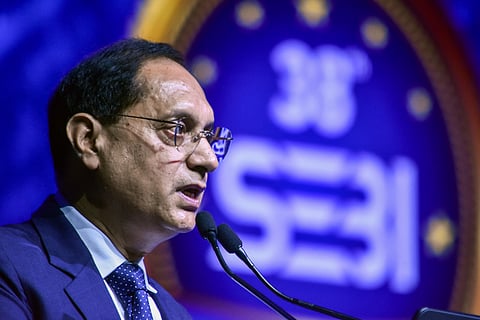
The market regulator’s advisory on prelisted premiums may fail to curb a market that has thrived for decades and largely operated under the shadows, away from the regulatory glare.. “There is a big army of such dealers and former sub-brokers in Gujarat and Rajasthan. In every small city, town, and village, you will find somebody who is willing to write a trade for you in the grey market,” said Deepak Jasani, an analyst.All the key centers of the grey market are interconnected and the prices fluctuate depending on demand and supply. Since most of these entities are not registered intermediaries, the Securities and Exchange Board of India (Sebi) may not have the necessary leeway or bandwidth to track their activity.“The players may introduce some safeguards or tweak their business model after the advisory, but it is unlikely anyone will shut down their business,” said Jasani.While the regulator has spoken about unregulated markets in public forums, this is the first time it has issued an advisory on grey market premiums. Sources believe the regulator received several complaints about attempts to unduly influence the listing price in recent large-sized issuances. The sheer size of the IPO market coupled with the development of the unlisted space may have also prompted the regulator to put out the advisory. Seventy eight companies raised ₹94,205 crore by way of mainboard IPOs in the first half of 2026-27, a record.“Grey market premiums can shape expectations, attract applications and reinforce oversubscription, creating a feedback loop detached from valuation, earnings quality, and governance. The risk is acute for retail investors in tier-2 and tier-3 cities, who may rely on such signals,” said Lokesh Manik, senior research analyst, Vallum Capital. .Sebi’s move, however, may be a credible step to strengthen investor protection and redirect IPO decisions towards full disclosures and fundamentals.Popular websites that disseminate information about grey market premiums include investorgain.com, ipowatch.in, and chittorgarh.com. Following Sebi’s release on Monday, ipowatch.in has put out its own advisory asking investors not to treat GMPs as a reliable sign of an IPO’s likely listing price, read the offer document, and consult their advisor before investing. “These informal quotes have no official price-discovery process and can change anytime without notice,” it said.“GMP figures are increasingly being treated as an indicator of likely listing gains, even though they have no reliable price-discovery mechanism. Sebi’s advisory should help investors focus more on fundamentals, valuations, and the company's financials rather than unofficial signals,” said Pranav Haldea, managing director at PRIME Database.SEBI has clear powers to regulate the conduct of its registered entities under Sections 11, 11A and 12 of the SEBI Act and the ICDR Regulations, accordingly to Abhiraj Arora, partner, Saraf & Partners. For newspapers and platforms that Sebi does not regulate, the advisory is persuasive only. The regulator could act against them only where the information is false or manipulative under the Prohibition of Fraudulent and Unfair Trade Practices Regulations, he said.Sumit Agrawal, managing partner at Regstreet Law Advisors, believes registered intermediaries quoting live rates for dealing, connecting buyers and sellers and presenting GMP as an expected return to drive subscriptions can amount to abetting an SCRA [Securities Contracts (Regulation) Act] offence. "Intermediaries would be well advised to treat this advisory as binding in spirit. SEBI may well follow it up with a formal circular, and an intermediary that ignored a clear public warning would find it very hard to plead good faith later," said Agrawal.